
# MDA: Know your opponents' ranges
The MDA section in Freebetrange gives you ready-made population preflop ranges based on mass data analysis of 300M+ real cash-game hand histories. In this section, you can select a specific player archetype and move through their full preflop decision tree spot by spot.
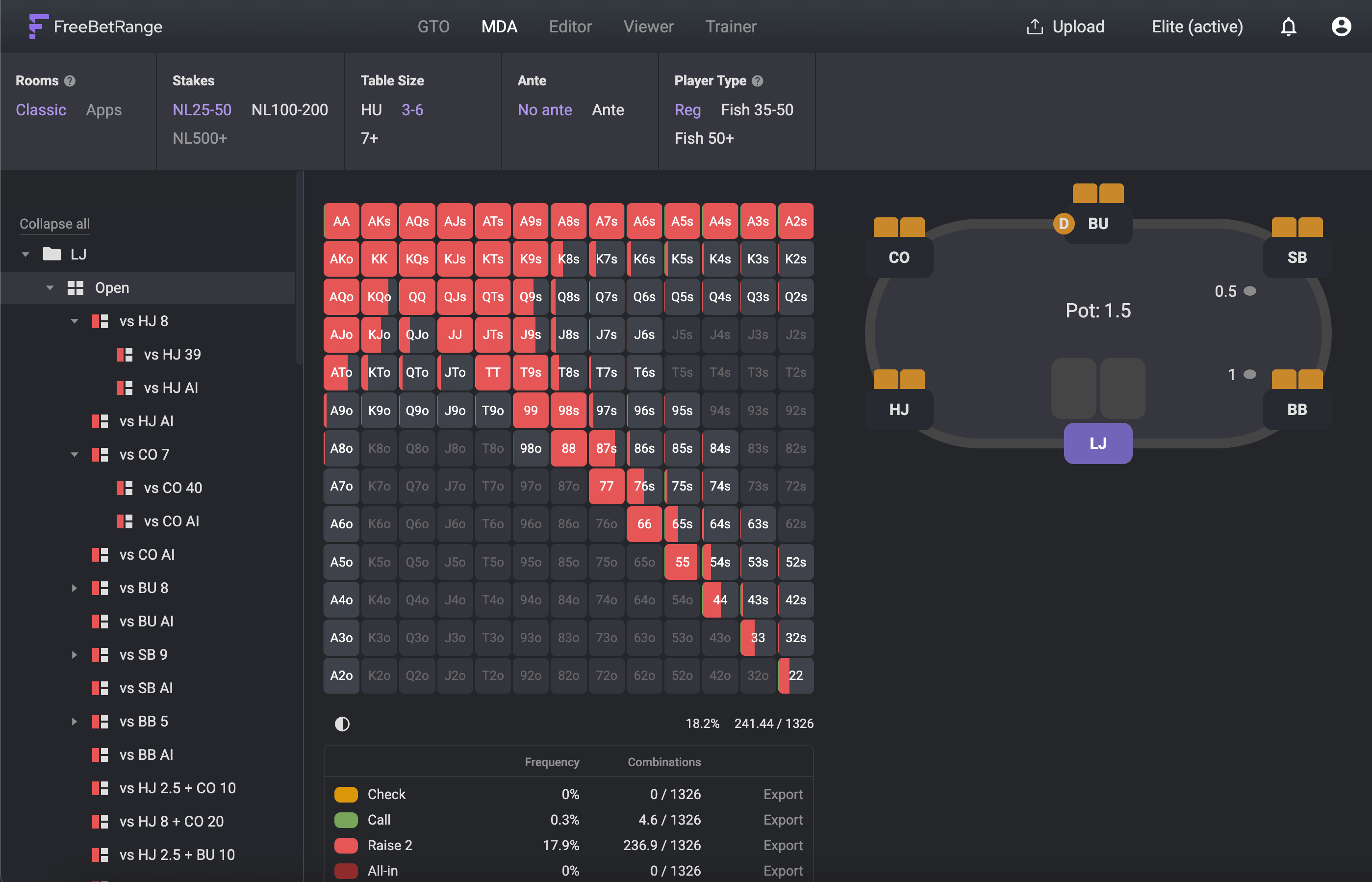
MDA gives you a massive edge far beyond GTO knowledge: it's not just theory, but a practical exploit blueprint to attack opponents' leaks and increase your winrate.
# Filters
You have a set of filters to explore preflop strategies for different player archetypes across different game conditions. When you change the filter combination, the preflop tree updates automatically to match the exact setup you selected.

# Rooms
Classic— major regular poker rooms (PokerStars, GG, WPN, 888, iPoker, ...).Apps— poker apps and club-style platforms (PokerBros, PPPoker, X-Poker, ...).
We intentionally combine rooms into two large groups. A single room may not provide enough hands to build accurate ranges, especially for fish archetypes where samples are naturally smaller. At the same time, play style differences between rooms inside each group are usually minor. By pooling rooms together, we significantly increase sample size (and range accuracy) while keeping almost all practical value.
# Stakes, Table Size, Ante
Available values:
Stakes: NL25-50, NL100-200, NL500+Table Size: HU, 3-6 max, 7+ maxAnte: No Ante, Ante
Play style can differ significantly depending on game parameters. These filters let you match MDA output to your exact game setup. Neighboring limits are grouped into pools on purpose. Their play style is usually close enough, while pooling them gives larger samples (especially for fish archetypes) and improves range accuracy.
# Player type
Reg:- SH (3-6 max): VPIP < 35, PFR < 30, VPIP - PFR = 0..15
- FR (7+ max): VPIP < 30, PFR < 25, VPIP - PFR = 0..12
Fish 35-50: VPIP = 35..49Fish 50+: VPIP > 50
This is the main filter, and the core reason to use this section: to study tendencies of different player types. Range differences between regs and fish in the same spots are often massive, and viewing them separately helps you adapt your preflop strategy to the exact opponent type you face.
# How MDA ranges are built
We used 300+ million real hand histories from the last several years to build preflop strategies for key player archetypes. The dataset is refreshed every six months to keep the population model up to date.
The key question is: how are these ranges built, and how accurate are they? There is a major challenge: showdown data is naturally biased. Some hand classes reach showdown more often, while many hands are simply folded before showdown and never revealed. So, pure showdown frequencies would distort the final ranges.
How do we solve this?
We use a statistical reconstruction pipeline to estimate hidden hand distributions from observed context and player actions. Showdown hands used as one of the signals rather than the only source of truth. Then we apply bias correction, combinatorial consistency checks, and smoothing/validation so the final ranges are stable, realistic, and internally consistent.
# Exporting ranges
You can export any range from the tree. Check the legend under the matrix: each action has its own Export button. Click it to instantly copy that action range to your clipboard.
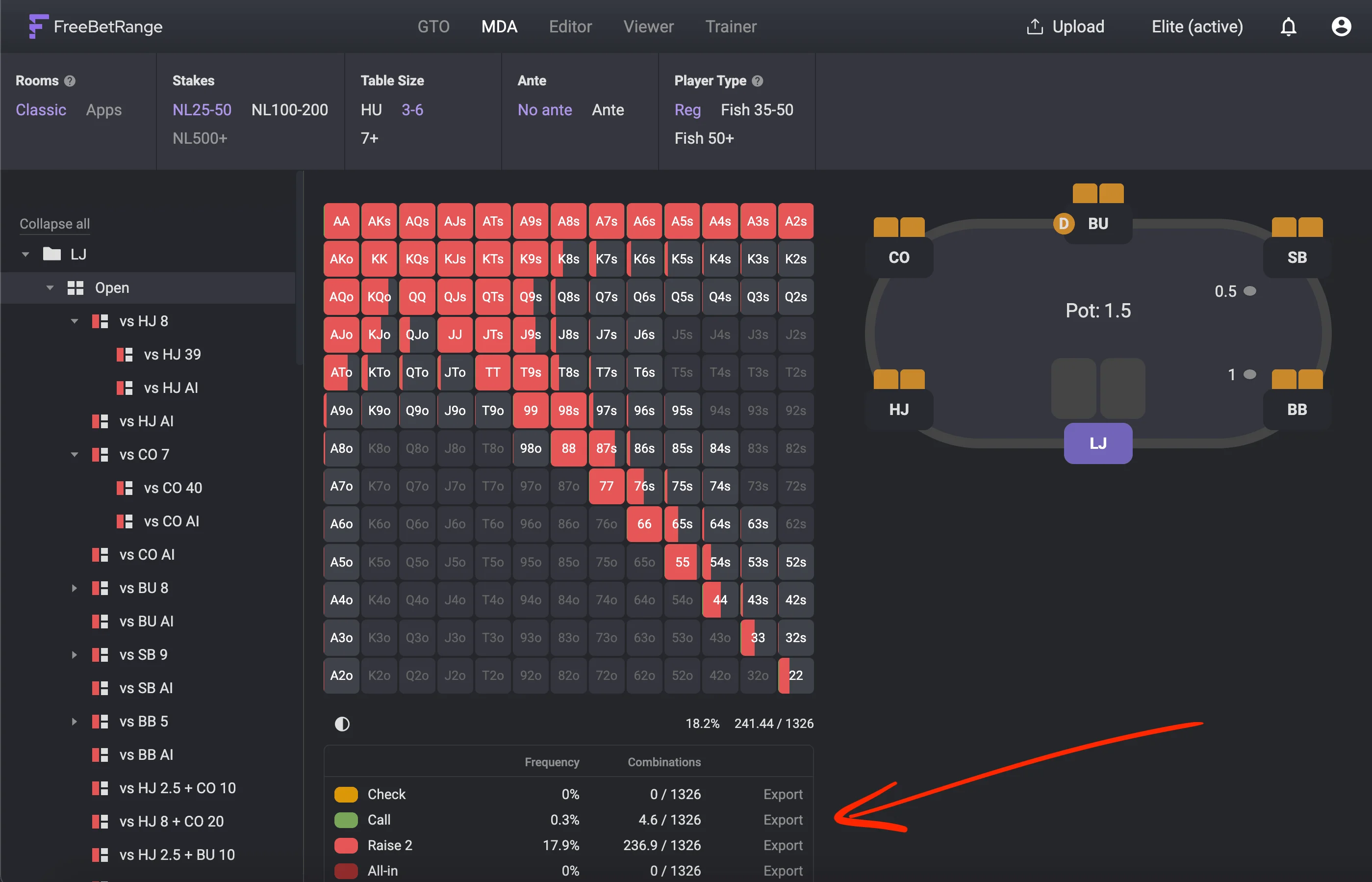
Then use the copied range in Freebetrange (for example, create a new range in Editor) or in external tools such as PioSolver or GTO Wizard.
# Access by plan
Free access includes only the LJ Open range at NL25-50 for basic feature preview. All other MDA content is available in the Elite plan.
Export limits depend on billing period:
- In the monthly Elite plan, you can export up to 100 ranges per month.
- In the yearly Elite plan, exports are unlimited.
For more details on plan differences, see Plan Comparison.
# How to apply MDA knowledge in practice
You know the real preflop ranges of key player archetypes in your games. This is highly valuable information that can give you a major edge at the tables.
# 1. Analyze hands against real ranges, not GTO defaults
During hand review, assign your opponent an MDA range for their archetype instead of a generic GTO range. This makes your analysis much more practical and accurate, because real opponents (especially fish) do not play close to GTO.
# 2. Build solver-based counter-strategies from MDA ranges
Use Export to copy any range from any spot in one click, load it into your solver, and calculate the best counter-strategy versus that exact archetype range. In future updates, this counter-strategy workflow will be available directly inside Freebetrange.
# 3. Train your pattern recognition
Do not rely only on technical tools. Regularly browse MDA trees the same way you study GTO trees, and memorize core population tendencies by spot. When approximate field ranges are already in your head, in-game decisions become faster and stronger.
Study both GTO and MDA!
GTO gives you the theoretical baseline, while MDA shows how players actually deviate in real games. When you understand both optimal and real-world ranges across many spots, your poker game moves to an elite level.
← GTO Library Viewer →